
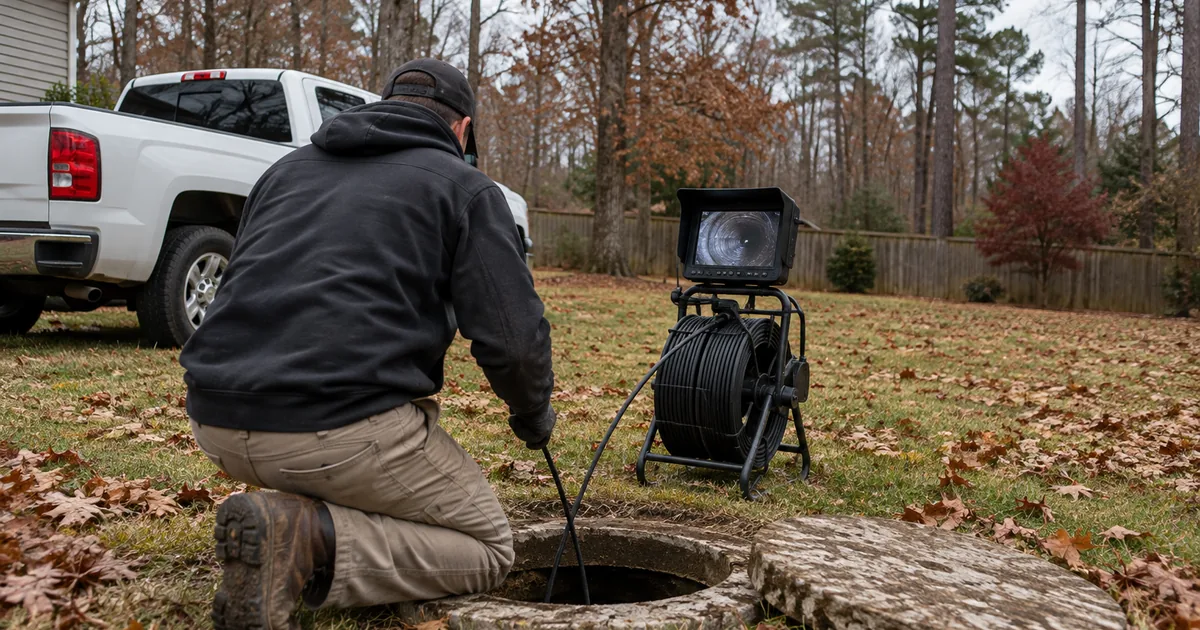
You can stand over a septic tank with the lid off and learn a lot. You can see the liquid level, the scum on top, the baffles and the outlet. What you cannot see from there is what is happening in the pipes that feed the tank and carry water away from it. That is where a camera comes in, and it is why a camera inspection often finds problems that a visual check of the tank simply cannot.
If you own a home in Acworth, Kennesaw, Marietta, Canton or anywhere else across metro Atlanta, here is what each type of check actually covers, what the camera adds, and when the extra step is worth it.
What a visual check covers
A standard visual inspection starts at the surface and works inward. The U.S. Environmental Protection Agency describes a typical septic inspection as including a review of the permit, design and pumping records, opening and inspecting the tanks, evaluating the sludge and scum levels, checking the effluent filter if there is one, and looking for signs of leaks or backup, such as low water levels or staining above the outlet pipe. The inspector also looks at the condition of the tank and the inlet and outlet pipes where they meet the tank, and at the yard for signs of system failure such as standing water.
That is valuable information. A visual check tells you whether the tank is full, whether the baffles or tees are in place, and whether the tank walls show corrosion. The Georgia Department of Public Health notes in its onsite sewage manual that baffles and concrete tees sometimes deteriorate and fall to the bottom of the tank, which lets solids pass into the soil absorption area. A visual check of the tank can catch that.
But a visual check stops where the pipe disappears into the ground.
What a camera adds
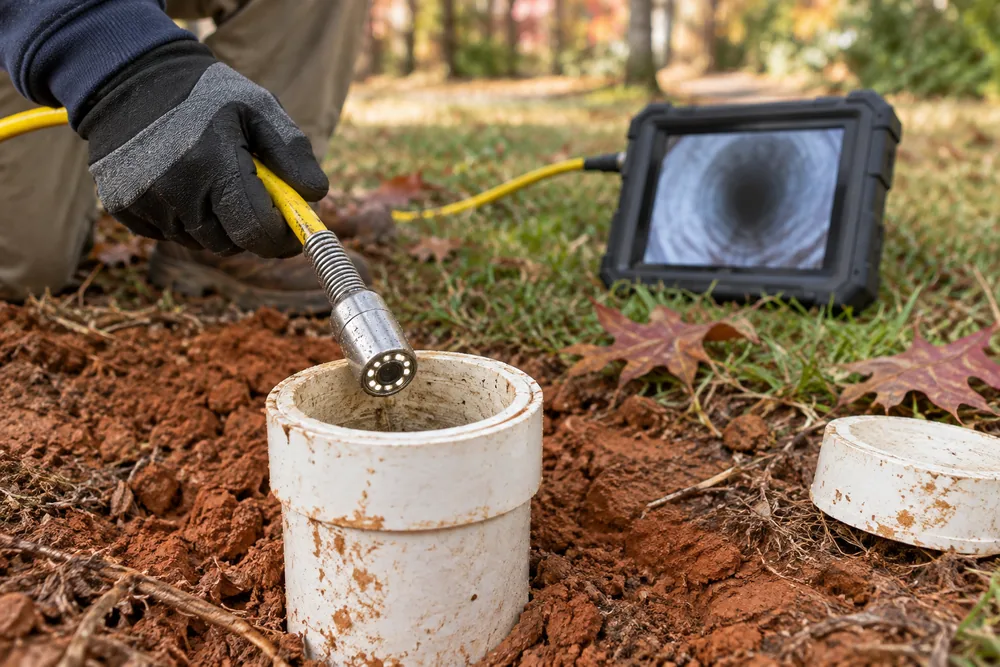
A camera inspection pushes a small waterproof camera through the pipes so you can see their inside walls on a monitor. On a septic property, the pipes that matter most are the line from the house to the tank (Georgia's rules call this the building sewer) and the outlet pipe leaving the tank. The EPA lists using a camera to look at solid pipes and leach lines for blockages or collapsed piping as something an inspection may include.
Industry sewer scope standards used by home inspectors give a good picture of what a camera can reveal. They treat all of the following as defects to report:
- Visible cracks, and broken, crushed, separated or collapsed pipe
- Root intrusion
- Offsets, where two pipe sections no longer line up
- Standing water in the line, which can point to a sag
- Blockages, heavy grease, scale or rust
Those are exactly the problems that make a septic system act up while the tank itself looks fine. Slow drains, repeat backups and a tank that seems to fill faster than it should can all trace back to a pipe problem, not a tank problem.
Roots are a good example. According to North Carolina State Extension, tree roots cannot create cracks in a sewer pipe, they can only exploit existing cracks or gaps. So when a camera shows roots in a line, it is also telling you there is a joint or crack that let them in. That changes the plan: clearing the roots may be the first step, but the opening they came through is the part that needs a decision.
What a camera cannot tell you
It is worth being straight about the limits. A camera shows the inside of pipes it can reach. It does not tell you how well the soil in your drain field is absorbing water. For the drain field, the EPA says inspectors look for surface signs such as standing water or unequal drainage, and sometimes dig into part of the field to look for ponding or groundwater problems.
Sewer scope standards also make a point that applies here: an inspection like this is not technically exhaustive, it reflects what was observed on the day, and it is not a prediction of future conditions. A line that is full of water or debris may need to be cleaned before the camera can see the pipe wall clearly. And if a cleanout is not accessible, the inspector notes what could not be inspected. A good report says what was and was not seen.
When the camera is worth it
- Buying or selling a home with a septic system. The EPA's homebuyer guide recommends having the system inspected before you purchase, and notes that inspections may be required by your local or state government or by your mortgage lender. A written certification letter, plus camera footage of the lines, gives both sides something concrete.
- Repeat slow drains or backups. If a pump-out did not fix it, or the problem came back, the cause may be in the pipes.
- Before a repair or jetting job. Seeing the line first means digging only where the work needs to happen and cleaning only what can be cleaned. If the camera shows a collapsed or broken pipe, jetting will not solve it and repair is the honest answer.
- An older home or a system with no records. Pipe material and condition are often unknown.
- Roots near the lines. Large trees close to the house-to-tank line or the outlet pipe are worth a look.
Why timing matters: after the pump-out
The best moment for a camera inspection on a septic property is right after the tank has been pumped. With the tank empty and open, the inspector can see the tank walls, the baffles and the outlet clearly, and can follow the lines from there. At One Way Septic, we run a camera down the main line and the outlet pipe after the tank is pumped, so hidden problems show up early. Ask about current offers on camera inspections with pumping when you request service.
Ask for the footage or a written summary, and ask what was and was not inspected. You want something you can keep with your septic records.
Frequently Asked Questions
Does a camera inspection replace pumping?
No. They do different jobs. Pumping removes the sludge and scum that build up in the tank. The camera shows the condition of the pipes. On a septic property they work best together.
How often should a septic system be inspected?
The EPA says a typical septic system should be inspected every one to three years, and pumped every three to five years depending on tank size, household size and water use. Systems with pumps or mechanical parts need to be looked at more often.
Does a clean camera report mean the whole system is fine?
It means the pipes that were inspected looked sound on that day. The drain field and the soil are evaluated separately, through surface signs and, when needed, a closer look.
Who is allowed to inspect or pump a septic system in Georgia?
Georgia requires septic inspectors and pumpers to be certified by the Department of Public Health. It is fair to ask any company about its certification before you book.
If you are buying, selling, or chasing a drain that will not stay clear, a camera can save a lot of guessing. Contact us or request a quote through our contact page and tell us what you are seeing. We will explain what we find in plain language and lay out your options.