
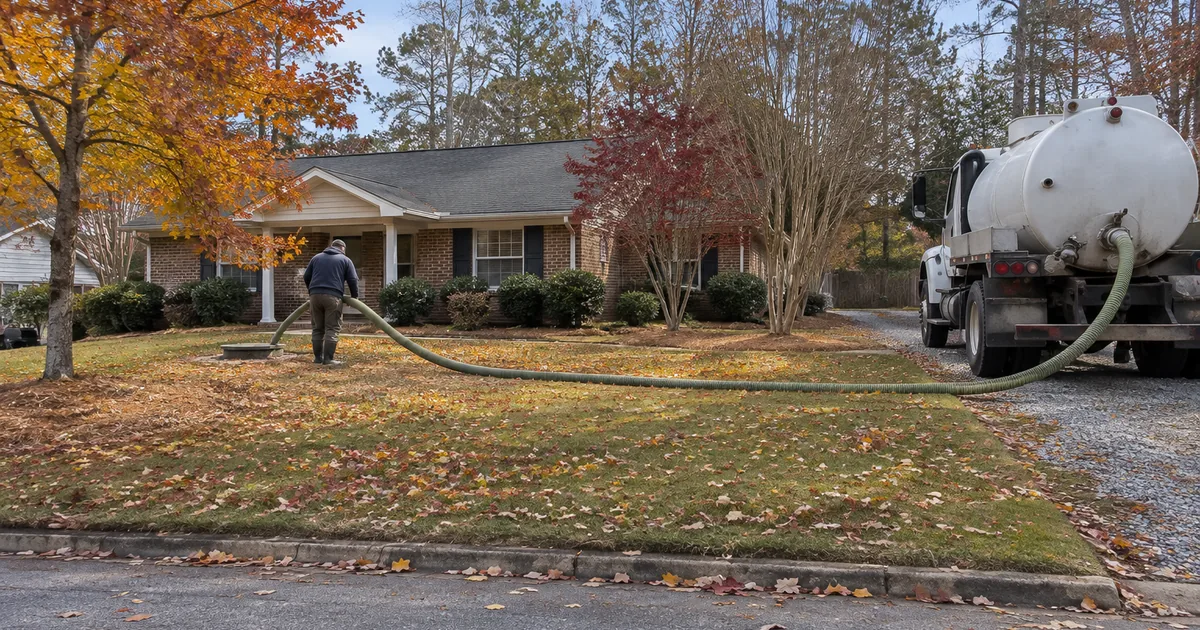
November is a good month to think about your septic tank, and not only because of the holidays. The leaves are down, so the yard is easy to read. The ground is usually not yet at its wettest. And a house that is quiet in October is often full of people by Thanksgiving, with extra showers, extra laundry and a lot more cooking.
If you live in metro Atlanta and cannot remember your last pump-out, this is a sensible time to settle it. Here is how to work out whether you are due, why before the holidays beats after, and what to do ahead of the truck arriving.
Are you actually due? The number depends on your house
You will often hear that a septic tank should be pumped every three to five years. That is the general guidance from the U.S. Environmental Protection Agency, which also says the right interval depends on tank size, the number of people in the household, water use habits, whether a garbage disposal is used, and how many solids have built up in the tank.
The Georgia Department of Public Health goes further and publishes estimated pump-out frequencies by tank size and household size. These are estimates, based on a minimum 24-hour wastewater retention time and half of the solids being digested. For a 1,000-gallon tank, which is the minimum size Georgia requires for homes with up to four bedrooms, the estimates are roughly:
- Two people: about 5.9 years
- Three people: about 3.7 years
- Four people: about 2.6 years
- Five people: about 2.0 years
A larger tank stretches those numbers. For a four-person household, a 1,250-gallon tank is estimated at about 3.4 years. The state's table also carries a warning: more frequent pumping would be needed if a garbage disposal is used.
The point is simple. A family of five with a 1,000-gallon tank and a disposal is not on the same schedule as a retired couple with a larger tank. If you do not know your tank size, the county environmental health office may have the permit records for your property, and a pumper can confirm it when the lid is open.
Why before the holidays, not after
Everything that goes down your drains ends up in the septic system, and a full house sends a lot more down. The EPA warns that doing all of the household laundry in one day can harm a septic system because it does not give the tank enough time to treat waste and could flood the drain field. Holiday weekends with overnight guests tend to push exactly that kind of load.
A tank that is already close to full has less room and less settling time. Solids and scum take up space, and when that space runs short, more solids can be carried toward the drain field. A tank that has just been pumped starts the season with its full working volume.
There is also a seasonal reason. Atlanta's winters are rainy: NOAA's 1991 to 2020 normals put December at about 4.6 inches of rain and January at about 4.6 inches, up from about 4.0 inches in November. The EPA advises against pumping a tank when the drain field is flooded or saturated, because in the worst case an emptied tank can try to float out of the ground. Doing the pump-out in November, while the soil is still more forgiving, avoids having to work around saturated ground later.
Get ready before the truck arrives
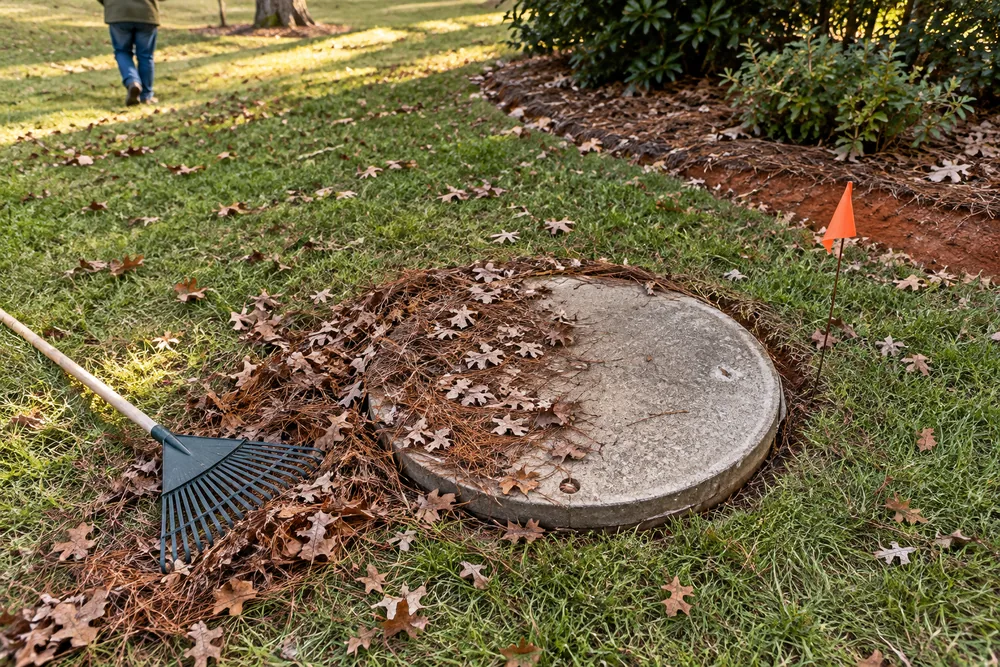
- Locate and clear the lids. Leaves and mulch pile up over tank access points in fall. If you cannot find them, check your records or ask your county environmental health office about a system map, and tell us when you request service.
- Clear a path. Move vehicles, trailers and yard items so the crew can reach the tank.
- Know your history. Have your last pumping date, tank size and any repair paperwork handy.
- Mention symptoms. Slow drains, gurgling, odors or wet spots help us decide what to look at once the tank is empty.
What a good pump-out should include
Pumping is the most common maintenance job for a septic system, but a pump-out that only empties the tank leaves information on the table. A thorough visit removes the sludge and scum, then looks at the tank walls, lids and baffle tees, and checks the lines. Georgia's own manual points out that bad seals and cracks left uncorrected can let groundwater in and overload a system, and that baffles which are no longer functional can pass solids into the absorption area. Both are far easier to see with the tank empty. At One Way Septic, we also run a camera down the main line and outlet pipe so we can explain what we found and let you decide what to do.
Holiday habits that help between pump-outs
- Spread laundry across the week instead of running every load on one day.
- Keep cooking fats, oil and grease out of the sink. Georgia's manual lists cooking fats and coffee grounds among the materials that should be disposed of another way.
- Go easy on the garbage disposal, since food waste adds solids.
- Remind guests that only human waste and toilet paper belong in the toilet.
- Skip septic additives. Georgia's Department of Public Health states that chemical or biological additives are not a substitute for pumping.
Frequently Asked Questions
Can I wait until after the holidays if the tank is probably fine?
If you are within your estimated interval and have no symptoms, you may be fine. If you are past it, or do not know when the tank was last pumped, a heavy-use week is a poor time to find out. Slow drains, gurgling, odors and soggy spots are signs not to wait.
Does a bigger family or more guests change how often I pump?
Yes. Household size is one of the main factors in every published schedule. A holiday crowd is a short-term load, while a permanent change in household size shifts the schedule.
Do I need to be home during pumping?
It helps, mainly so we can confirm lid locations and talk through what we find. If you cannot be there, tell us how to reach you and where the lids are.
Is it safe to pump when the ground is wet?
Not always. The EPA advises against pumping during flooded or saturated drain field conditions. If heavy rain has the yard soggy, ask us before scheduling.
If you are in Cobb, Cherokee, Bartow, Paulding, Douglas or any of the other counties we serve and want your tank checked before guests arrive, contact us or request a quote through our contact page. We will explain what we find and what, if anything, needs attention.